esg.

Why are we moving ESG (“E“ for Environment, ”S“ for Social and “G“ for Governance) into the spotlight? Because it is an integral part of our green. smart. and more. strategy.

green. stands for measures in support of greening, meaning the redirection of the economy in line with the environment. Our primary focus is on timber construction as well as renewable energies and green building certification.
smart. expresses our commitment to intelligent buildings. With the use of sensors and automation, buildings can be adapted to meet the needs of users and, at the same time, operations can be made more efficient.
and more. means we tell stories with our buildings. This involves aesthetics, well-being and customer experience – a “more“ that is perceptible all over.

The efficient use of resources is an integral part of ongoing operations, as are social issues and adherence to compliance rules. UBM’s flagship projects, green building certifications and the activities evolving from the green. smart. and more. strategy reflect the requirements of the EU and create new opportunities for UBM. This starts with the acquisition, leads to the question of whether a project can be realized as a timber construction, and ends with the building’s carbon footprint over its entire life cycle. In other words: ESG defines UBM’s entire value chain.

It is, therefore, only logical that we are also committed to integrating the UN Global Compact and its principles into our corporate strategy, our corporate culture and our daily business activities in order to support the UN Sustainable Development Goals. Our ESG report follows the recognized GRI Universal Standards 2021 issued by the Global Reporting Initiative. And UBM is also one of the first companies on the Vienna Stock Exchange to establish an ESG committee at Supervisory Board level. We are especially proud that this is the first UBM committee to be exclusively female.

Leading worldwide ESG rating agencies have confirmed UBM’s strong position in the area of sustainability. We invite you to accompany us into a green. smart. and more. future.
fundamental principles.

UBM is committed to the United Nations Sustainable Development Goals (SDGs), which were adopted by all UN members in 2015 as the 2030 Agenda for Sustainable Development. Governments as well as companies are called upon to make a contribution to reaching these goals.
In connection with a materiality analysis and a risk and impact assessment, UBM dealt with the SDGs and the related sub-goals in detail and identified the goals where the company can make a direct contribution to the Agenda 2030.

Our actions are also based on the ten principles of the UN Global Compact. UBM joined this “Network of the Future“ in 2021. Moreover, UBM has been an official supporter of the Task Force on Climate-related Financial Disclosure (TCFD) since 2021, joining more than 4,000 organizations in demonstrating a commitment to safeguarding against climate risk and building a more resilient financial system through better disclosures. In 2024, our ambitious science-based climate targets were validated by the Science Based Targets initiative: UBM is committed to a 42% reduction in scope 1 and scope 2 GHG emissions by 2030 (from a 2022 base year), and to reaching net zero by 2050 (90% reduction in scope 1+2+3 emissions by 2050 from a 2022 base year and neutralizing the remaining emissions) to help keep global warming to 1.5 °C.

An intensive dialogue with stakeholders is guaranteed and reinforced by UBM’s participation in various organizations and industry associations. The company has been a member of the Institute for Corporate Governance (ICG) since 2019 and contributes to the ICG’s social impact investment initiative. In addition, UBM is a member of respACT (Austrian Council for Sustainable Development), VÖPE (Association of Austrian Project Developers), ÖGNI (Austrian Sustainable Building Council) and the IG Lebenszyklus Bau, among others.

                           

goals and measures.

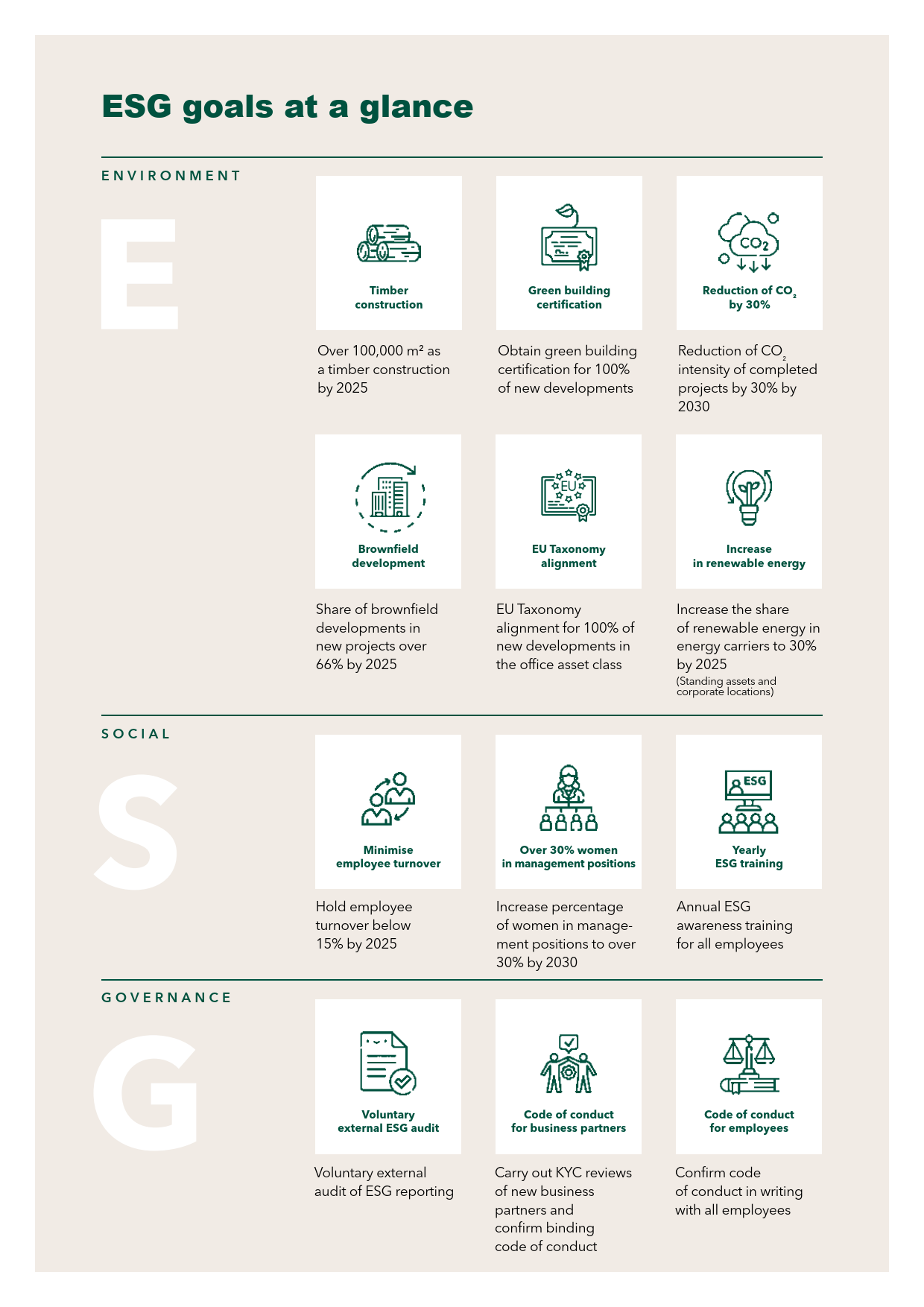
With our corporate strategy green. smart. and more., we have firmly embedded ESG objectives across all areas of our company. In 2025, we set ourselves new, ambitious ESG targets to further strengthen sustainable corporate management.

To ensure consistent implementation of this strategy, we have defined over 50 specific measures and measurable KPIs across all three key focus areas: Environment, Social, and Governance. Our environmental goals, which contribute to decarbonisation, are also integrated into the UBM Climate Transition Plan. The Investor Relations & ESG department coordinates the development of ESG targets in close collaboration with relevant corporate functions, before they are approved by the Management Board.

Transparent governance structures ensure the effective implementation and monitoring of our sustainability goals. At Management Board level, responsibilities for each ESG dimension are clearly defined. The respective specialist departments are responsible for operational implementation, ensuring that agreed measures are effectively integrated into day-to-day business.

Progress is regularly reviewed and reported to both the Management Board and the ESG Committee, providing a comprehensive overview of the current status and achieved results. In addition, the ESG targets are assessed annually for feasibility, taking into account market and regulatory developments. Where necessary, they are adjusted to ensure continuous improvement.

Environment

Sustainable Real Estate Development
  • Target “Timber Construction”: Construction of 100% of new buildings using timber (hybrid) construction methods¹, by conducting technical, economic, and ecological feasibility assessments for all new developments.

  • Target “Building Certification”: Building certifications (BREEAM, LEED, DGNB) for 100% of new buildings with at least the second-highest rating², and compliance with EU Taxonomy for 100% of office developments by integrating the technical screening criteria as a prerequisite.

  • Target “Green Lease”: Conclusion of Green Leases for 75% of leased office space by establishing Green Lease clauses as a standard option in all new lease agreements.

1 Provided this is permissible under the applicable legal requirements.

2 New developments in the residential asset class with a project volume of at least 5,000 m² gross floor area (GFA).

Decarbonisation
  • Target “Emission Reduction”: Reduce Scope 1 and 2 GHG emissions by 42% by 2030 and achieve Net Zero by 2050 by reducing Scope 1+2+3 emissions by 90% (base year 2022) through the implementation of a detailed transition plan, continuous emission reduction measures, and neutralisation of residual emissions from 2050 onwards.

  • Project Development
  • Target “Energy & CO₂”: Compliance with the primary energy demand for zero-emission buildings in Austria and Germany, and for nearly zero-energy buildings in the Czech Republic and Poland. Reduce the average operational CO₂ emissions of all new developments by 50% by defining binding primary energy demand thresholds, using renewable energy sources, and installing energy-efficient building equipment.

  • Target “Life Cycle Assessment”: Conduct Life Cycle Assessments for all new developments¹ as a mandatory part of our building standards.

  • Standing Assets & Group Locations
  • Target “Energy & CO₂”: Reduce average operational CO₂ emissions of all standing assets by 25% and group locations by 50% through renewable electricity sourcing and by establishing guidelines for sustainable and efficient building operations.

  • Target “Fleet”: Ensure that at least 50% of company vehicles (owned and leased cars) are equipped with electric or full-hybrid drives by promoting the purchase of vehicles with corresponding drives and establishing a new acquisition policy.

  • Target “Business Travel”: Reduce CO₂ emissions from air travel by 50% through the introduction of a corporate air travel guide for employees.

1 New developments in the residential asset class with a project volume of at least 5,000 m² gross floor area (GFA).
Resource Use & Circular Economy
  • Target “Sustainable Building Materials and Circular Economy”: Calculate the circularity factor for 50% of new developments with a target value of 45%, and increase the use of recycled building materials by creating a digital building resource passport to document installed construction products and materials, and by purposefully using recycled and recyclable building materials.

Biodiversity & Ecosystems
Project Development
  • Target “Brownfield Development”: Ensure that at least 75% of the project pipeline consists of brownfield sites by focusing acquisition activities on brownfield and conversion areas.

  • Target “Biodiversity”: Calculate the average biotope area factor for all projects by determining the project-specific factor in accordance with DGNB criteria or using the Berlin Biotope Area Factor method.

Water and Wastewater Management
Standing Assets & Group Locations
  • Target “Water Efficiency”: Improve efficient water use in standing assets and group locations by installing flow restrictors and raising employee awareness through sustainable building operation guidelines.

Social

Attractive Employer
  • Target “Win over and Retain the best Employees”: Win over and retain the best employees, aiming for an employee turnover rate below 12.5%, by further developing a strong employer brand to enhance our attractiveness as an employer for both prospective and current employees. Measures include intensified use of online platforms such as LinkedIn and Instagram, adherence to a structured onboarding process for all new employees, flexible working models, competitive compensation packages, proactive parental leave management, regular internal communication, internal training and qualification programmes, the development of a company-wide mobility programme, promotion of internal career development, exit interviews, and structured succession planning.

Training and Education
  • Target “BuildingBetter”: Promote employee development through at least six annual “BuildingBetter” sessions and the gradual establishment of an internal knowledge center for structured sharing of expertise, best practices, and industry insights.

  • Target “Employee Training”: Provide at least ten hours of training (internal and external) per employee by agreeing on individual, needs-based training measures during the annual performance review.

  • Target “ESG Awareness Training”: Provide annual ESG awareness training for 100% of employees by enabling all staff to actively participate in an ESG training session aimed at building awareness and understanding of ESG topics.

Diversity and Equal Opportunities
  • Target “Empowering Women”: Achieve a 50% share of women across the workforce and 30% in management positions by prioritising equally qualified women in recruitment, supporting participation in women’s networks, and introducing mentoring programmes for high-potential female employees.

  • Target “Equal Pay for Equal Work”: Eliminate pay differences between women and men in comparable positions by introducing transparent salary bands and closing pay gaps.

Health and Safety
  • Target “Health and Safety”: Maintain and promote employee health and prevent workplace accidents by protecting the mental and physical well-being of employees through a modern occupational health and safety management system in accordance with ISO 45001, as well as through fitness programmes and subsidies, an in-house occupational physician, an internal contact point for mental health and conflict counselling, regular safety training sessions, and annual audits of all sites to ensure compliance with occupational safety standards.

Governance

Corporate Governance & Compliance
  • Target “Ensuring Corporate Compliance and Responsible Conduct” through the annual self-evaluation of the Supervisory Board, including an assessment of its organisation and working methods; the maintenance and continuous improvement of a process-oriented quality management system in line with the highest standards (ISO 9001 certified); the transparent implementation of the ESG remuneration model through the publication of relevant ESG targets in the remuneration report; and the case-related enhancement of the Compliance Management System (CMS) as well as its related policies and work instructions.

  • Target “Implementation of Policies and Prevention of Misconduct through Consistent Preventive Measures”: Prevent misconduct and ensure adherence to internal policies through annual training on capital market compliance and compliance with a focus on anti-money laundering for 100% of new employees and at least 60% of existing employees, including regular updates and expansions of the training materials. In addition, ongoing training for compliance staff and certification of the compliance team according to international standards (ISO 19600 and ONR 192050) are carried out. Regular random checks are conducted to ensure compliance with regulations regarding insider information and the handling of confidential and price-sensitive information. Furthermore, employees’ awareness of internal policies is ensured through documented acknowledgement confirmations.

  • Target “Ensuring Ethical, Moral, and Legally Compliant Employee Conduct” by requiring all new employees to sign the company’s Ethics Code in their local language.

  • Target “Ensuring a High Level of Data Protection” through the continuous enhancement of data protection measures.

  • Target “Prevention of Money Laundering and Terrorist Financing” through ongoing KYC checks using disclosure forms for all new business partners, regular updates of the company’s internal risk analysis in these areas, and the systematic reporting of suspicious transactions in compliance with legal requirements via the goAML system of the Federal Criminal Police Office (Bundeskriminalamt).

  • Target “Structured Assessment of ESG-Related Risks within Risk Management” through semi-annual evaluations of ESG risks and opportunities conducted by the Management Board.

Sustainable Procurement & Regional Added Value
  • Target “Ensuring Environmental and Socioeconomic Compliance in the Value Chain” through the written and binding agreement of the Code of Conduct with new business partners and its documentation in the central evidence management system, as well as the annual review of key suppliers with regard to their ESG activities.

ESG Reporting

ESG Reporting
  • Target “Transparent ESG Reporting in line with Internationally Recognised Standards” by providing progress reports within the framework of the UN Global Compact, publishing an annual voluntary ESG report in line with internationally recognised standards, and continuously improving ESG data collection in terms of quality, documentation, and processes. Additionally, ensure voluntary step-by-step alignment with EU Taxonomy requirements, external validation of the Climate Transition Plan and the Corporate Carbon Footprint every three years, and voluntary external audit of ESG reporting.

  • Target “Green Finance” by preparing an annual Allocation Report and continuously developing the Green Finance Framework.

  • Target “Optimisation and Expansion of Internal Reporting and Monitoring Systems” through measures such as an interactive dashboard.

  • Target “External Evaluation of ESG Performance” by undergoing ESG ratings conducted by leading international rating agencies.

esg contact.

Larissa Alterdinger
ESG & Investor Relations Manager Larissa Alterdinger

Christoph Rainer
Head of Investor Relations Christoph Rainer